
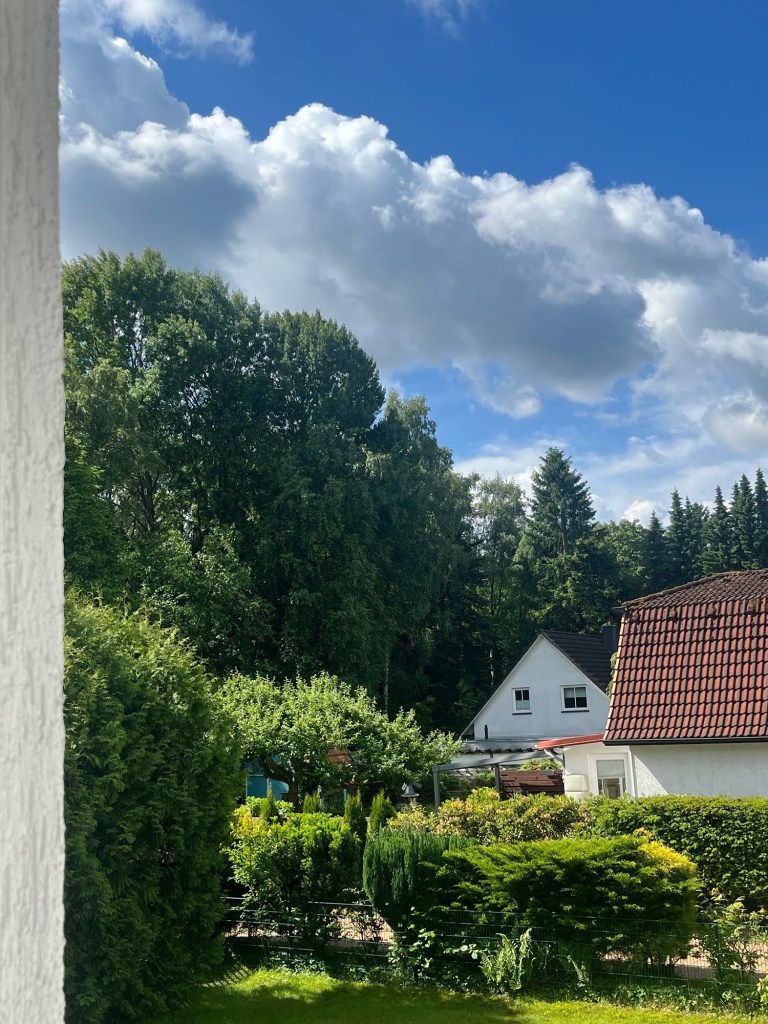
Through the kitchen window, a quiet world unfolds—where clouds drift like wool above a garden of greens and memories.
There’s a quiet kind of art that unfolds not on canvases or stages, but in the small rituals of our days: the way light shifts across a room, the scent of herbs warming in a pan, or the way our gaze drifts toward the sky when we pause at a window. These are the unspoken poems that surround us — fleeting, unassuming, but full of life.
For me, one of these moments happens at my kitchen table. From where I sit, I can see a stand of old and tall cypress trees rising like green spires against the sky. On certain days, the clouds drift past them — soft, white, and woolly — and I find myself daydreaming. They remind me of the felt I work with, the quiet texture of wool in my hands, its softness and potential. I lose time there, watching the sky, slipping into reverie. It’s not a grand moment, not something to display, but it feels sacred — and deeply creative.
This is what I call the poetry of the everyday — a way of dwelling in the world that allows beauty to surface through presence and attention. Creativity doesn’t always demand effort. Sometimes it simply asks us to slow down, look, and feel.
Slowing Down to See
In the rush of daily life, beauty often hides in plain sight. But when we choose to slow down, the world reveals itself — textures on a wall, the play of shadow and light, the way sunlight warms the floor in late afternoon. These are not subjects for art; they are art. Noticing them is a form of gentle resistance against haste. It’s an invitation to reinhabit the present moment.
I believe creativity is a matter of attention. To notice is to care. And to care — truly — is already an act of creation.
Domestic Spaces as Landscapes of Beauty
We often separate “art” from the space of living. But our homes — with their clutter and comfort — are full of meaning. A worn tablecloth, the sound of water boiling, the placement of a stone or bowl — these carry memory and rhythm. They are not static; they shift with the seasons and our moods.
In these intimate landscapes, I find inspiration. The kitchen becomes a studio. The hallway, a gallery of light. And sometimes, just arranging dried flowers in a glass jar becomes a silent poem.
Walking and Wonder
When I walk, I don’t search — I receive. A broken tile, a fluttering leaf, the sudden blue of a jaybird — they arrive as gifts. I carry them home in memory. Some become drawings. Some remain as felted forms, colors, or textures. Others stay unnamed — just part of the invisible thread that weaves through my practice.
Walking, for me, is not just movement — it’s a way to be in dialogue with the world.
Memory, Material, and the Everyday
What touches me most deeply are not always “beautiful” things, but things that resonate — that remind me of somewhere, someone, something. A pattern in pavement might recall the rhythm of Persian carpets. A scent in the air might pull me into childhood.
Even in felt-making, these echoes return. A curl of wool becomes a cloud. A hand-sewn stitch becomes a path. The materials I choose carry memory — and that memory carries me.
Practicing a Gentle Gaze
There is a softness in choosing to see the world tenderly. Not naively, but with openness. In a time of noise and speed, to honor the ordinary is an act of care. It is a way of staying human.
Every day offers a canvas — not to be filled, but to be witnessed. I think that’s where real art begins: not with the need to produce, but with the willingness to receive.
So today, I sit again at my table. The clouds are passing slowly, like thoughts not yet formed. The cypress trees stand watch. And I remember that this moment — quiet, unnoticed by the world — holds all the beauty I need.
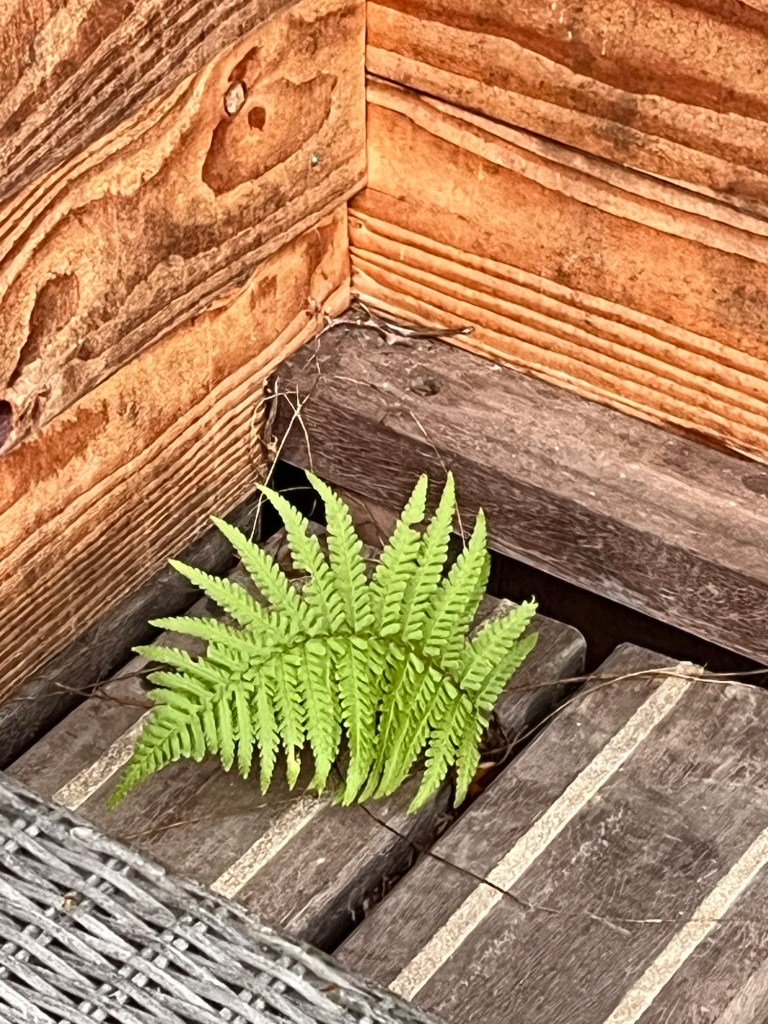
Grace between the cracks — a quiet fern reminding us that beauty often grows where we least expect it.
 Felt, Paint & Reflection