
On the invisible balance behind every act of creation
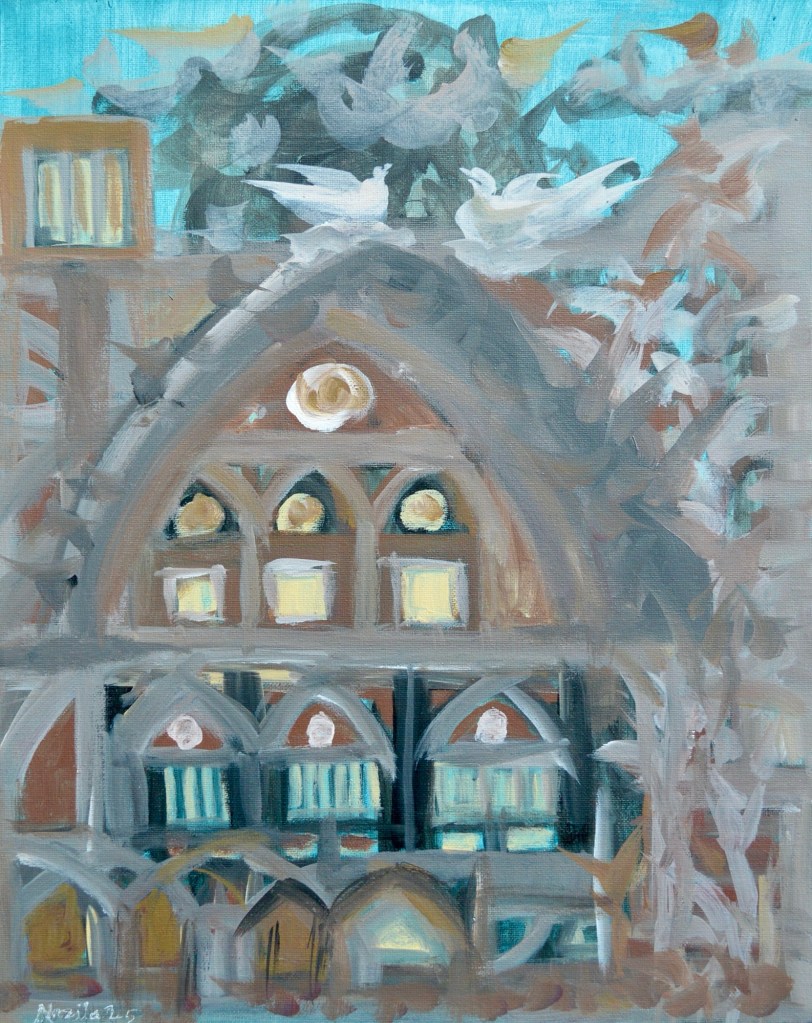
A composition of quiet architecture and fleeting flight — where balance emerges not from symmetry, but from the unseen rhythm that holds all parts together.
Before we ever speak of beauty, we sense it. And often, what we sense is not the subject, but the structure — something quietly holding everything together. Like bones beneath skin. Like silence between notes. Like the way a window turns the outside world into a painting. We are moved by harmony long before we understand it.
Symmetry, for example, is something we are drawn to from a very young age. It gives us a sense of order, a feeling that things are in place. There’s a comfort in its balance — two hands, two eyes, a house mirrored on both sides. But the most powerful works of art, the ones that stay with us, often don’t rely on symmetry. Instead, they are built on another kind of balance — a quieter one, harder to name. A hidden geometry that brings everything into relationship.
Every meaningful composition — whether a painting, a felt collage, or even the way objects are arranged on a table — carries a hidden structure. Not a visible grid, but an internal rhythm. Over time, I’ve learned that every shape, every colour, even the pauses between them, holds weight. A strong composition allows this weight to be felt and balanced — like offering the eye a path to travel without fatigue. A well-composed piece invites the viewer to linger, to wander slowly, and to keep discovering. The more one looks, the more details begin to surface — each one a part of something larger, a single particle belonging to a complete whole.
Composition, of course, is a foundational subject in fine art education. There are many types — symmetrical, diagonal, radial, triangular — each offering a different emotional quality and spatial rhythm. But what matters most, I believe, is the relationship between the elements. When a composition works, it’s not because it follows a formula, but because it speaks a visual truth.
Through years of creating and observing, I’ve also learned that overthinking often leads me away from that truth. Whenever I try to construct a composition too consciously, it begins to feel disconnected from my emotions. I’ve damaged many pieces by trying to “fix” something that was never broken. That’s why most of my artworks — even my felt compositions — emerge without a pre-planned structure. I trust my eye and my feelings. If the final piece carries the emotional honesty I felt while making it, I know it has found its balance.
This hidden balance can sometimes reflect something even deeper — a timeless proportion. The golden ratio, found in nature, architecture, and classical painting, has long been associated with harmony and visual beauty. Though I don’t calculate it when I create, I often sense it in the works that feel most whole. It’s as if this geometry lives quietly beneath the surface — not imposed, but remembered. Not constructed, but felt. In that sense, composition becomes a memory of order — something ancient the body recalls before the mind understands.
Hidden geometry exists in almost every meaningful work of art — whether we notice it or not. It holds the elements together and gives the piece a sense of quiet balance. When we train our eyes and minds to observe more closely, we begin to recognize these underlying structures — not as rules, but as relationships. Over time, this way of seeing becomes intuitive. And with it, our experience of beauty deepens — not just in art, but in the world around us.
 Felt, Paint & Reflection