
A few years ago, the phrase “nothing is sacred” was everywhere.
It became a slogan, a protest, a shrug against meaning.
I understand its origins. The sacred has too often been used as a tool for exclusion, control, or even violence.
But still — I don’t agree.
For me, the sacred does exist.
Not as something to be defended, but as something felt.
It’s not grand or absolute. It’s not something I can explain.
It arrives in certain moments — uninvited, quiet — and leaves just as quietly.
I’ve come to believe that the sacred must remain personal.
Not secret, but private. Not argued for, not performed.
Because what is sacred to one person may be meaningless — or even offensive — to another.
That doesn’t bother me. It’s part of being human.
We each carry our own inner compass, our own vocabulary of reverence.
But when the sacred becomes a fixed symbol, a flag we wave, a weapon we carry —
then we lose the very thing we’re trying to protect.
As an artist, I don’t try to create sacred art.
Yet I know that when I work from a place of honesty — without self-censorship, without the need to explain —
something beyond me finds its way in.
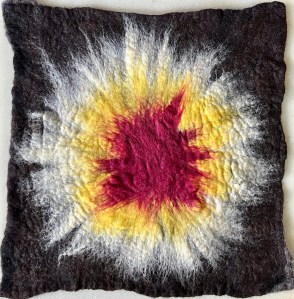
I leave the edges of my felt pieces uneven, soft, uncorrected.
I write the name of God with my painting brush — not as a calligraphy exercise,
but as an honest call to the energy that surrounds me.
I stop a painting before it’s polished.
I don’t aim for perfection — I aim for presence.
And it’s often in that raw, unfinished state that I sense a kind of blessing.
Not one that tells me I’ve succeeded — but one that whispers:
You showed up. You didn’t hide. You told the truth.
That, for me, is enough.
My sense of the divine doesn’t need to be spoken aloud.
It moves silently through the work — not as a statement, but as a current.
Even when I don’t name it, it’s there —
in the empty space,
in the thread of colour,
in the quiet between gestures.
So yes, my beliefs are private.
But my work is public.
And between the two, something invisible passes through.
 Felt, Paint & Reflection