

Sometimes, when I feel too much in my head or too far from the ground, I open one of my old books. I turn to them not to analyze, but to reconnect—to feed my eyes and heart with what feels like home.
I opened two familiar books today to get some inspiration for my ongoing felt collage that is not talking to me anymore—one on Persian pottery, the other on carpet motifs—and as always, the same language appeared again in different forms.
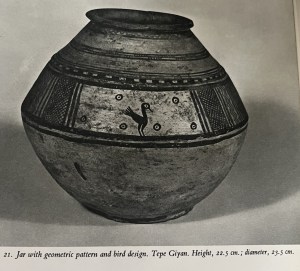
A bird drawn on a jar from Tepe Giyan—simple, nearly abstract—reappears in a carpet motif a thousand years later, this time woven with wool. A tree of life. A bull’s horn. A spiral. A flower flattened into perfect symmetry. Shapes that once decorated clay now live in borders, medallions, and fields of woven rhythm.
These aren’t coincidences. They’re memories.
Not copied, but remembered.
Not repeated, but carried forward.
And I realized: this is how I work, too.
In my felt collages, I simplify. I cut away until only the essence remains. A petal, a wing, a face. I’m not trying to replicate reality. I’m trying to feel it again, as they did—those early potters and weavers who didn’t think in terms of art, but of meaning. They left behind not just beauty, but presence.
When I sit with these books, I’m not researching. I’m just feeding my eyes with something close to my heart. I need that sometimes. To be reminded that what I do with my hands is part of something older, wider, quieter.
A thread that stretches not just across pages, but across time.
This post is part of my personal series “Pages from the Past,” where I open one of my books on Persian art and follow the forms that still speak to me today…
 Felt, Paint & Reflection