
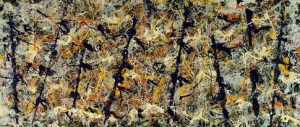
Blue Poles, also known as Number 11, 1952, is an abstract expressionist painting by the American artist Jackson Pollock.
Recently, I heard an Iranian artist criticize Jackson Pollock’s paintings. He dismissed them as nothing more than what one might find in a car-painting workshop: random splashes, messy surfaces, and above all, a product of money and market hype. He also expressed his disappointment that art students in Iran must study Western art in depth, while the reverse rarely happens in Western academies.
At first, I didn’t respond. But his words stayed with me. They made me reflect not only on Pollock’s role in art history, but also on the deeper question of whose art is considered worth studying, and why.
Pollock and His Time
Jackson Pollock’s drip paintings were indeed ridiculed in his own lifetime. Many critics accused him of making a mess and calling it art. Yet looking back, his work was revolutionary for its time. Pollock abandoned the easel, laid the canvas on the floor, and painted with sticks, hardened brushes, or even by pouring paint directly. Painting became an act, an event, almost a performance.
This approach helped to establish Abstract Expressionism, a movement that shifted the center of modern art from Paris to New York in the years after World War II. Pollock’s canvases were not just pictures; they were arenas of energy and gesture, challenging what painting could be. In that sense, they were brave and transformative, not simply random splashes.
The Question of Value
It is true that Pollock’s paintings now sell for astronomical prices, which makes it tempting to see them as symbols of the art market’s obsession with money. But their high value also reflects their historical role: they embody a cultural shift, a statement about freedom, individuality, and even America’s post-war identity. Whether we admire or dismiss them, Pollock’s works carry weight far beyond their painted surfaces.
Whose Art Do We Study?
My colleague’s frustration, however, touches a deeper truth. In Iran, students are expected to learn Western art history in detail, but the reverse rarely happens in Western institutions. Iranian, Indian, African, or Chinese modernisms are often treated as footnotes, while Western narratives dominate the global curriculum.
This imbalance reflects power structures, not artistic merit. Western art has been presented as “universal,” while the art of other regions is framed as “local” or “particular.” Yet every culture has its own revolutions, its own Pollocks: artists who challenged tradition, broke rules, and redefined what art could mean.
Toward a Wider Dialogue
Perhaps the answer is not to dismiss Pollock as meaningless splashes, nor to unquestioningly accept him as a genius. Instead, we might place him in dialogue with artists from other traditions. By doing so, we can appreciate his contribution while also acknowledging the many parallel revolutions that Western art history has long ignored.
In the end, Pollock’s drips are more than car paint. They are a reminder of how art can break boundaries. But the bigger challenge before us is to make sure that all boundaries – cultural, geographical, educational – are crossed, so that students everywhere can learn from both Pollock and from the artists who redefined art in Tehran, Isfahan, or Shiraz.
 Felt, Paint & Reflection