
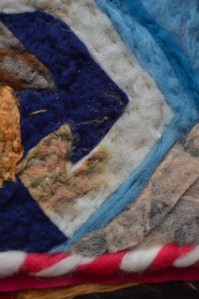
Persian motifs are more than decorative forms in my work—they are part of my identity, woven into my memory, language, and sense of self. These patterns and symbols, passed down through generations, are not just aesthetic references; they are emotional anchors. Through them, I feel rooted—never entirely a stranger, no matter where I live.
In my art, I do not simply replicate traditional Persian motifs. I reimagine them—sometimes abstracted, sometimes subtly altered—allowing them to evolve alongside my own experiences of displacement, solitude, and belonging. Whether in the spiral of the Eye of God, the geometry of carpets, or the organic rhythms of gardens, these forms serve as a bridge between past and present, between my heritage and the world I now inhabit.
Each motif carries the quiet force of memory. Even in unfamiliar landscapes, they offer me a place to begin—a visual language that speaks of home, continuity, and transformation. By reworking them through felt, paint, and thread, I make space for both remembrance and reinvention. These are not just patterns—they are the shape of my being.
 Felt, Paint & Reflection